Far from trying to hide his thievery, Fleming took care to leave clues at every turn.

For instance, in On Her Majesty’s Secret Service, when three different people caution Bond with the phrase "mind your head,” the author is slyly letting readers know that 007 has stumbled into a reenactment of that Middle-English romance about a beheading-game played at Christmas, Sir Gawain and the Green Knight.
When he cradles Tracy’s lifeless body at the end of the book, numbly muttering that “She’s having a rest,” he might be in denial, but he’s also foreshadowing the next book in the series, based in part on another Middle-English poem, Sir Orfeo.
In the first chapter of From Russia, With Love Red Grant has been reading an early P. G. Wodehouse thriller, The Little Nugget. In fact, all of the possessions laid out near the sunbathing Grant are made of gold or are related to gold. We are meant to see the repellently reptilian Grant as a dragon sprawled beside his golden hoard, suggesting the role he will eventually play when Tatiana Romanova's Cinderella story turns into a deadly variation on "Sleeping Beauty."
The first six Bond films, released between 1962 and 1969, cemented the public's expectations for a standard Bond adventure: high living in exotic locales, romantic dalliances without commitment or consequences, colorful villains, outlandish schemes, and assorted action set-pieces of varying degrees of incredibility. The six were all adapted from books which Fleming wrote during the final two-thirds of his career, after he had found his footing and his muse.
Fleming's primary muse was Walt Disney.
The plot of the very first Bond novel selected for filming, Dr. No, seems to chart a parallel course with a live-action Disney adventure film from 1954. The second Bond film, based on Fleming's previous book, From Russia, With Love, borrows many of its story elements and characters from an animated Disney classic released in 1950, combined with the plot of another Disney film which was still in production as Fleming finished typing his manuscript.

Fleming seemed to get wind of where the Disney train was headed next, and managed to pull into the station ahead of it. When Disney turned his attention to a fantasy about a wee red-haired man who grants golden wishes, so did Fleming. Darby O’Gill and the Little People was released to theaters three months after the publication of Goldfinger.
Prodded by the Broadway success of Lerner and Loewe’s Camelot, the Disney team dusted off a long-dormant project based on the first volume of T. H. White’s Arthurian tetralogy, The Once and Future King. Fleming countered by shaping the classic Arthurian romance Sir Gawain and the Green Knight into that James Bond thriller with the cumbersome title. The Sword In the Stone and On Her Majesty’s Secret Service reached the finish line together in 1963.
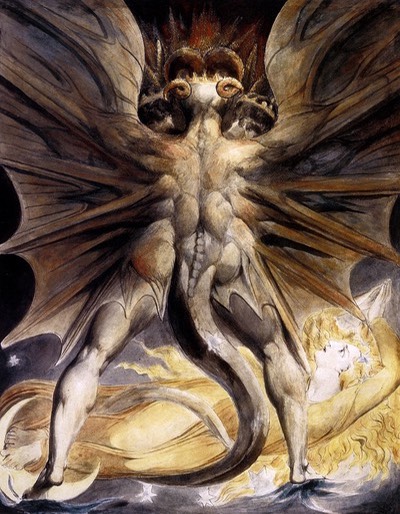
Fleming’s FRWL opens with apocalyptic imagery based on a William Blake paintings
So, why should we imagine that any of Ian Fleming's novels are based, not just on fairy tales, but the Disney version of those tales? We only need to glance back at the book where, inspired by his mentor Raymond Chandler’s remark that each of his recent thrillers had been worse than the last, Fleming decided to give it all he had.
Within the first few pages of Fleming’s fifth novel, From Russia, With Love, we meet a dragon which is about to be summoned by an evil old crone who owns a set of poisoned needles.
At the climax of the story the beast will stand guard over a slumbering princess to prevent the handsome young hero from disturbing her eternal nap. Fortunately, her rescuer has been equipped with a sword that can pop into his hand as if by magic.

KEYWORD SEARCH
Search for names and other keywords across this site, including over seventy blog entries. Enter text in the field below and then click the “search" button.
LINKS TO RECENT POSTS
Looking Deeper into Marnie
One Solution to an Old Problem
Probably Not the Year You Think
The Origin Story of Krilencu
Why Noon is the Hour of the Gun
Casting Bond from Then Till Now
Firing on All Cylinders
In addition to being a solidly-grounded spy thriller, From Russia With Love has been fitted out with the essential characters and props from “Sleeping Beauty,” which was at that very moment being turned into an animation masterpiece by the Walt Disney Company.
But there’s more than one connection here with a Disney film - in fact, more than one animated Disney film based on a fairy tale. Until the moment when a beautiful former-ballerina reprises a role which she may have danced years earlier on a stage in Leningrad, she is forced to be part of a perverse Cinderella-story.
Instead of scheming to prevent her beautiful stepdaughter from arriving at the Palace and being introduced to the prince, as Lady Tremaine does in the Disney film, Rosa Klebb smuggles Tatiana Romanova into the Kristal Palas - James Bond’s hotel. As Bond takes his bedtime shower, the girl enters his room and then slips between the sheets clad in nothing more than the black velvet ribbon Cinderella wore around her neck..
Several other refugees from the 1950 Disney Cinderella are given meaty roles. Those thieving mice which the compassionate young heroine befriends, her family’s faithful hound Bruno, and a malevolent feline named Lucifer, are transformed as if by the wave of a fairy godmother’s magic wand, into a band of gypsies, the hero’s stalwart confederate Kerim Bey, and the cruel Krilencu. Like Lucifer, Krilencu is chased out of a high window and plummets to a cobbled street.
It soon becomes clear why Bond calls attention to Kerim’s bloodshot, watery eyes, which Bond compares to the eyes of a hound who has slept too long, too close to the fire.
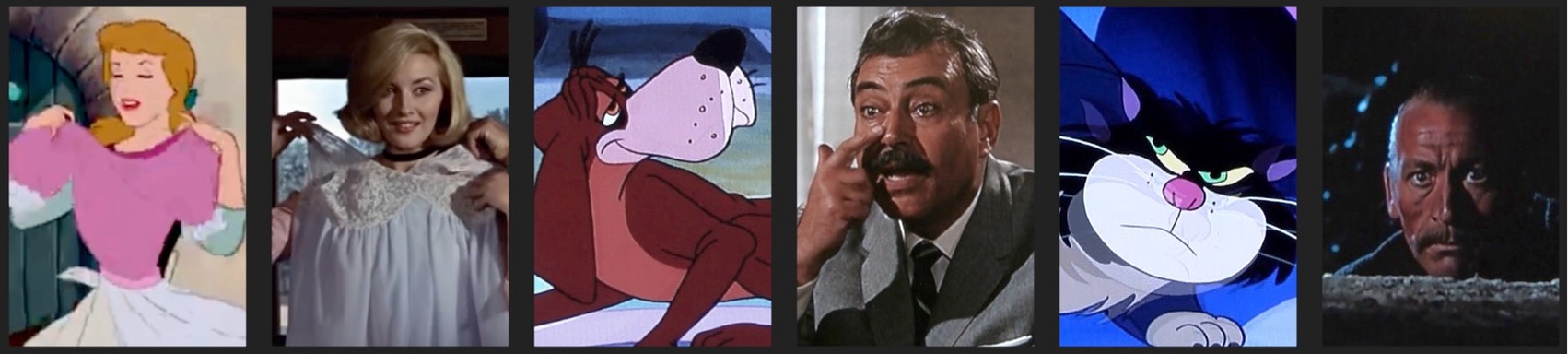
Beauties, Bloodhounds and Skulking Villains from Walt Disney’s Cinderella and MGM/UA’s From Russia With Love
This is how Ian Fleming began to reinvigorate his spy series with From Russia, With Love, setting off a run of entertaining novels based on fairy tales, Disney films, TV Westerns, and Chivalric romances. After capturing world-wide attention, the books would be turned into a celebrated series of movies that soldiers on to this day.
What follows on these pages is not meant to be a pedantic dissection of Fleming’s later novels, but a personal story of the sort of small discoveries which have undoubtedly been made by many casual readers through the years.
I read Fleming before ever getting the chance to see a Bond film, and started reading his books while he still had a few more left in him. When I finally caught up with the films, I watched them out of order, the same way I had read the books - at least the ones that made me keep turning the pages all the way to the end. It didn’t occur to me at the time that the order might be crucial for understanding the long, tangled path of an unlikely hero’s journey.
Although Fleming's thrillers contain some of the standard devices we're told about in school when we study great literature, Fleming wasn’t in the business of writing great literature. He crafted books to be read for fun, books that would sell because they’re a blast to read. If we spot his many references to classic tales and the popular entertainment of his own day, we’re probably meant to enjoy them as an overgrown schoolboy's spoof of highfalutin writing.
Think of the scene from the film Animal House where a professor (played by Donald Sutherland) who, while discussing Milton’s Paradise Lost, writes “Satan” on the chalkboard and then stands next to the word, grinning slyly as he munches on an apple. The obvious labeling is already amusing, but becomes richer as we realize that it's absolutely on the mark. He really is Satan. As every college student learns, it's part of a professor's job description to open innocent minds and sow doubt.
In a similar vein, when Bond first lays eyes on Honey in Dr. No and imagines her as a goddess, readers should take note. The scene leads to a great payoff when Honey turns out to be an actual goddess - just not the one Bond was thinking of.
In Fleming’s Bond novels we can appreciate the underlying myths, fairy tales and Disney cartoons if we choose to, or just sit back and enjoy the scenery. But even if we smile at the author’s ingenuity when we spot his recurring themes, we understand that they’re not intended to pack the weighty wallop of those Biblical allusions in The Grapes of Wrath or The Old Man and the Sea. When Bond quotes the Bible or even quotes Jesus, it’s not because we’re supposed to view James Bond as some sort of Christ-figure.
Although, come to think of it, Bond is condemned by his enemies and brutally tortured. And of course he's killed and then raised from the dead (three times by my calculation), so you could probably make a case for it. But not seriously.
On the other hand, by the time we get to Thunderball where the final trajectory of Fleming's Bond saga begins to take shape, if we remember nothing we learned in school about mythology, Greek tragedy, Arthurian Romances, or Middle-English poetry, we're in danger of missing the best jokes.
(A Link to the Bond Blog)

Dr. No Goldfinger Thunderball The Spy Who Loved Me OHMSS You Only Live Twice